The Eight-Year Silence After Silver Lake
In the spring of 2018, A24 quietly walked Under the Silver Lake to the curb. After multiple release-date shuffles and a Cannes premiere that split the room down the middle, David Robert Mitchell's shaggy Los Angeles noir was dropped into theaters with the kind of minimal marketing push usually reserved for films a distributor has stopped believing in. Then Mitchell went quiet. Not the strategic quiet of a director hopping between projects — the total quiet of a filmmaker whose last movie became a career-stalling event.
The whiplash was the story. It Follows had been the horror movies phenomenon of Cannes 2014, the rare indie chiller that broke out of the festival circuit and became a genuine cultural object, its synth score and unblinking wide compositions imprinted on a generation of imitators. Silver Lake was supposed to be the follow-up that vaulted Mitchell into auteur canon. Instead it became the film that critics used as shorthand for indulgence — a director allegedly drunk on his own mystery-box logic.
Eight years later, he is back with a canvas he has never had before. The End of Oak Street arrives on August 14 with an $85 million Warner Bros. budget, IMAX cameras, and Ewan McGregor and Anne Hathaway at the top of the call sheet. The math there is genuinely startling: a filmmaker whose last feature grossed well under its budget has been handed roughly ten times the resources and turned loose on a studio-scale summer release. Warner Bros. bet that Mitchell's cult status could scale. Everyone in the industry is watching to see if that bet pays.
The stakes reach beyond one filmmaker. Trade coverage of early screenings has framed Oak Street as a canary for mid-budget original science-fiction viability — a test case for whether non-IP, director-driven science-fiction movies can still find an audience at scale. If it works, it cracks a door open. If it doesn't, that door closes for a lot of people who never got as far as Mitchell did.
Metro Detroit, 1982: Why the Setting Is the Argument
Oak Street is Mitchell's third feature set in the suburbs north of Detroit, following The Myth of the American Sleepover and It Follows. Those suburbs are not scenery. They are his subject, the way Lynch's Pacific Northwest or Malick's Texas plains are subjects — a specific American geometry that he keeps rearranging until it tells him something new.
The 1982 setting is doing more work than nostalgia. It positions Oak Street inside the 1980s movies Spielbergian mode — kids on bikes, powerlines humming over cul-de-sacs, a childhood that gets interrupted by something enormous — while quietly tilting the frame off-axis. Mitchell's suburbs are always slightly wrong. The kids in Sleepover drift through their own town like it's a maze they can't map. The infected in It Follows walk in straight lines toward well-kept lawns. The uncanny movies is not something that visits his neighborhoods; it's the load-bearing wall.
The dinosaur premise sounds like high concept until you learn the film is dedicated to Mitchell's late father. Suddenly the frame shifts. This is not a monster movie about creatures in a subdivision. It's a memory piece using genre iconography as emotional excavation — the way E.T. the Extra-Extra-Terrestrial-adjacent kid-adventure imagery is really about parents, absence, and the moment the world stops being safe.
SlashFilm's report from a 20-minute footage screening explicitly contrasts Mitchell's approach with Jurassic Park: where Spielberg shoots his dinosaurs for wonder, Mitchell shoots his for dread — closer to a suburban nightmare than a theme-park ride. That distinction is the whole argument. Anyone can put a dinosaur on a suburban street. Mitchell is trying to make you feel the way you felt the first time you realized your neighborhood had places in it you weren't supposed to go.
The Auteur Signature: Dream Logic, Shadows Rising
Speaking to MUBI's Notebook around Silver Lake, Mitchell described his interest in "shadows rising" — a purgatorial noir logic that treats reality as a puzzle box the protagonist cannot ultimately solve. That's the sentence to keep in your pocket walking into Oak Street. It's the through-line. Sleepover is a film about kids trying to find people who keep slipping away. It Follows is about a curse that cannot be outrun, only handed off. Silver Lake is about a man convinced that the city is a code and finding out — maybe — that the code is real and also useless.
Early reactions to Oak Street describe the same signature: unresolved ambiguity, a mystery-box structure Time Out compares to Super 8 and Lost, with a distinctly Mitchell interior underneath a Spielberg-by-way-of-Abrams surface. The recurring obsessions are all here: adolescence as horror, suburbia as haunted architecture, pop-culture ephemera as coded language whispering at the edge of the frame.
This is why the cinephile stakes on this one are unusually real. If Oak Street works, it retroactively vindicates Silver Lake — recasts it as a step forward rather than a stumble, a director working out the grammar he needed for a bigger canvas. The people who defended that film on Film Twitter for eight years are about to find out whether they were early or wrong.
What the Early Screenings Actually Say
The Hollywood Reporter's compilation of first reactions from press screenings has been strikingly consistent: the word "home run" recurs, and multiple reviewers note that the film pushes its PG-13 rating to its absolute edges — harrowing rather than family-friendly, closer to the tone of an early Amblin production that would have been R today.
J.J. Abrams also stepped in personally to shut down the persistent Cloverfield-connection rumor mill that had been building around the film's marketing — this is a standalone Mitchell picture, not a franchise seed. That matters. In a summer where every original-seeming release turns out to have a shared-universe tether, Oak Street is defiantly one movie.
Time Out's review positions it as the summer's premier "WTF" sci-fi mystery — its surface texture inviting the Spielberg and Abrams comparisons, its interior operating on Mitchell's own dream logic. Reviewers keep returning to a single word: ambitious. This is a filmmaker swinging for a scale he has never had access to before, and the early consensus is that the swing connects.
Start a Watchlist
Keep track of every movie that catches your eye. Your watchlist, your rules.
Start Your WatchlistThe Prep-Watch Trilogy: Reading Mitchell Before Oak Street
Three films form the Mitchell prologue. Not a marathon assignment — a lineage. Watch any one of them and Oak Street will land differently.
The Myth of the American Sleepover
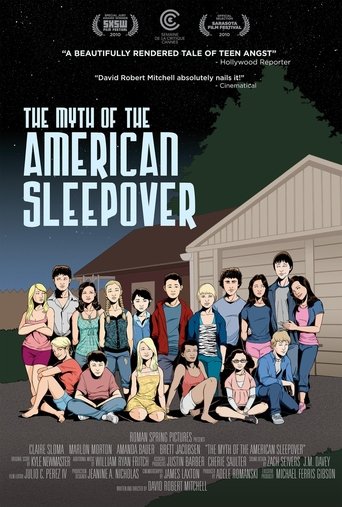
Mitchell's Sundance micro-budget debut established the suburban gaze that everything since has refined. Teenagers drift through a single humid Michigan night, chasing crushes and phantoms in equal measure, and the camera wanders with them in long, watchful geometry. Watch for the way Mitchell frames neighborhoods as labyrinths — every yard opening onto another yard, every party bleeding into the next — because that spatial logic is exactly what he's scaling up in 1982 Metro Detroit. The emotional register, nostalgia laced with dread, is the tonal blueprint.
It Follows
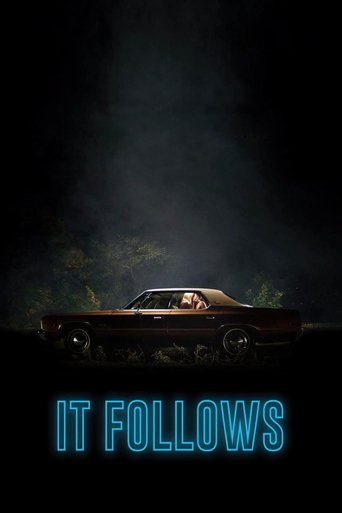
The breakthrough. A horror movies film that treats suburban-dread movies as an inheritance, an infection passed between bodies, a thing that walks toward you at the speed of a slow adult across a parking lot. Rich Vreeland's synth score became the film's signature almost immediately, and Mitchell's insistence on wide, unblinking compositions — letting the horror enter the frame from the background rather than jump-scaring it in — became the template for a decade of imitators. Its cult status is what earned him the freedom to make Silver Lake. And now, whether directly or not, the leash to make Oak Street.
Under the Silver Lake

The burial. A shaggy Los Angeles noir that critics called either a masterpiece or an indulgence, with almost no middle ground and very little air between them. Andrew Garfield plays a stoned Angeleno decoder convinced every cereal box and pop song is a hidden message, and the film is really about the seductive lie that everything means something — that the puzzle can be solved if you just look at it long enough. It has aged into a genuine cult object. Watching it now, on the runway to Oak Street, is the closest thing to reading Mitchell's diary about what he thinks movies are for.
Why This Is the August Movie That Matters
August has become the graveyard where studios dump ambitious originals — the shelf where mid-budget director films go to die a quiet death between the Marvel calendar and awards season. Oak Street landing on August 14 is either an act of confidence, a hedge, or possibly both.
For cinephiles, the release doubles as a referendum. Can the mid-budget auteur thriller movies still exist at studio scale in 2026? Can a director whose previous feature was buried get handed IMAX cameras and a top-shelf cast on the strength of cult reputation alone? Rotten Tomatoes' overview frames the project as Mitchell's most ambitious to date, and the industry-defying comeback narrative — eight years of silence, then an $85 million mystery movies — is not a story that happens often anymore.
The stakes go beyond Mitchell personally. A hit here helps unlock financing for the next generation of directors trying to make original science fiction that isn't downstream of a comic book or a video game. A miss makes every one of those pitches harder for the next five years. That's the actual weather system this movie is being released into.
Eight years is a long silence. The fact that Mitchell broke it with dinosaurs, Metro Detroit, and his father's memory — three of the least obviously commercial swings a director could take with $85 million — is exactly the swing his admirers were hoping for. Whether it connects is a question August 14 will answer. Whether it should have been made at all is a question the film has already settled.