The Spring That Confirmed It
Three weeks. That's all it took, in early 2026, to retire any remaining argument about who the most essential screen actor working right now actually is.
In February, Sandra Hüller walked off the stage at the 76th Berlinale holding the Silver Bear for Best Leading Performance, awarded for her role in Aurora Fearnley's Rose. By April, the first stills had landed for Pawel Pawlikowski's Fatherland, slotted into Official Competition at the 79th Cannes Film Festival, with Hüller playing Erika Mann opposite Hanns Zischler's Thomas Mann. And looming over the multiplex calendar: Project Hail Mary, the Ryan Gosling-led adaptation of Andy Weir's novel, with Hüller in the major supporting role anchoring its emotional weight.
Deadline has taken to calling her the European actress-of-the-hour. Letterboxd's Ella Kemp described her work as titanic. The critical consensus isn't building anymore — it has arrived, fully formed, sitting at the intersection of the world's two biggest festivals and the multiplex at the same time.
What follows isn't a ranking. It's a tour through six performances that, taken together, make the case that no working screen actor has Hüller's current range — and that calling her the defining actor of the 2020s is just an honest reading of the math.
The Breakthrough Nobody Saw Coming
Toni Erdmann
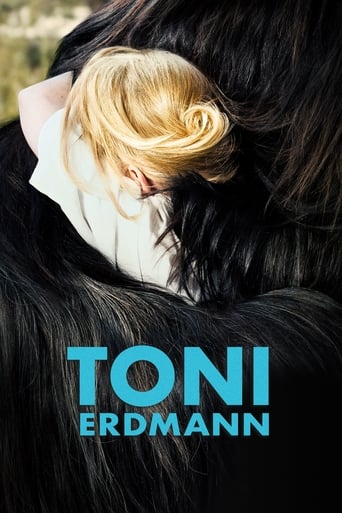
Maren Ade's 2016 Cannes sensation is where Hüller arrived fully formed, even though she'd been working in German theater and film for over a decade. As Ines Conradi, a corporate consultant whose estranged father starts crashing her life in Bucharest with novelty teeth and a wig, Hüller turned her face into a battlefield between professional armor and inherited grief. Watch her in the boardrooms: every micro-expression is a calculation about how much feeling is permissible.
Then comes the naked birthday-party scene — a masterclass in using humiliation as liberation — followed by the karaoke rendition of "Greatest Love of All," still the most quietly devastating musical moment of the 2010s movies. It's not a "look at me" performance. It's a performer disappearing into a woman who has spent years disappearing into herself, and slowly, painfully, choosing to come back.
Toni Erdmann reset what an arthouse comedy movies could do, and every Hüller role since lives partially in its shadow. It's the film that taught audiences her real specialty: holding two contradictory emotional registers in the same shot, and refusing to resolve them.
The One-Two Punch That Changed Everything
If 2016 announced Hüller, 2023 made her unavoidable. In a single calendar year, she headlined two of the most discussed films of the decade — and the casting contrast between them is itself the demonstration of range.
Anatomy of a Fall
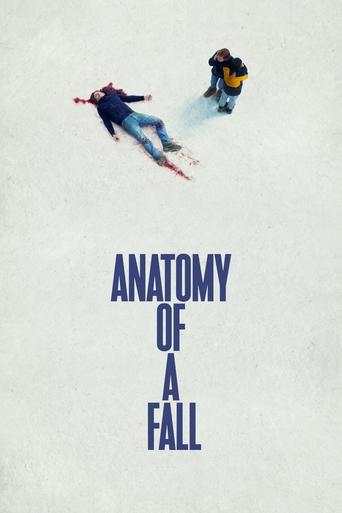
Justine Triet's Palme d'Or winner is, on its surface, a legal-drama movies about a writer accused of murdering her husband. In Hüller's hands, it becomes something stranger and more lacerating: a marriage autopsy conducted in public, where the audience never quite knows whether Sandra Voyter is a killer, a wronged widow, or something more uncomfortable than either.
Her trick is to turn ambiguity itself into a performance. She doesn't play "innocent who looks guilty" or "guilty who looks innocent" — she plays a woman whose interior life is genuinely irreducible to a verdict. The Oscar, BAFTA and César nominations followed, but the more telling response was how thoroughly the film dominated cinephile conversation for a year. People didn't argue about whether the performance was great. They argued about what it meant.
The Zone of Interest
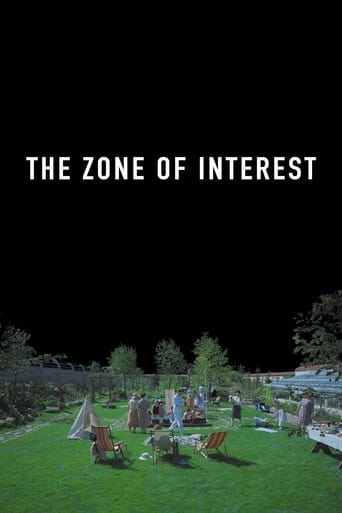
Then, in the same year, the cruelest counter-casting imaginable. Jonathan Glazer's Holocaust film places Hüller as Hedwig Höss, the wife of Auschwitz commandant Rudolf Höss, tending her garden and trying on a stolen fur coat in a bourgeois idyll built directly against the camp wall. Where Sandra Voyter is opaque and possibly sympathetic, Hedwig is transparent and unmistakably monstrous — a woman whose moral horror is precisely her ordinariness.
No actor in the 2020s has held two films of this stature in a single year. The contrast — sympathetic suspect versus oblivious perpetrator — is the whole point. Most actors spend a career trying to demonstrate range. Hüller demonstrated it across two films in twelve months, in two languages, for two of the most demanding auteurs working.
The Berlin Winner
Rose
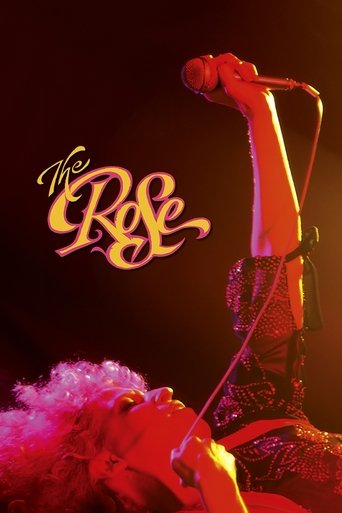
The 76th Berlinale was a strong edition, but the festival's critical consensus pointed in one direction. Aurora Fearnley's Rose topped Screen International's Berlin jury grid with a 3.3 average and five four-star reviews — an unusually decisive showing in a competition designed for disagreement.
The Silver Bear for Best Leading Performance followed, and the post-festival sales rush confirmed the film's commercial heat: MUBI picked up rights for North America, the UK, Latin America, Italy and beyond, signaling that this will be one of the year's most-discussed arthouse releases. THR's David Rooney called it "an eloquent demolition of the gender binary" — a phrase that captures the film's ambition without quite preparing you for the quietness of Hüller's work in it.
What's striking about Rose, compared to her recent run, is how interior it is. Anatomy of a Fall is verbal warfare; Zone of Interest is monstrous obliviousness; Toni Erdmann is operatic mortification. Rose is something else — smaller, more inward, more patient. The fact that she keeps finding new gears this late into a career-defining run is what makes "ceiling" the wrong word. The ceiling is still rising.
The Cannes Pivot
Fatherland
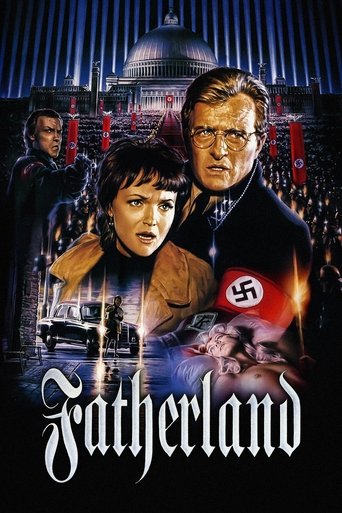
Three months after Berlin, the first image dropped from Pawlikowski's Fatherland, slotted into Official Competition at the 79th Cannes Film Festival. Hüller plays Erika Mann opposite Hanns Zischler's Thomas Mann in a Cold War-set drama that, even in a single still, looks unmistakably like a Pawlikowski film: monochrome, severe, every frame a held breath.
It's a natural fit. Pawlikowski's monochrome formalism in Cold War and Ida demands actors who can carry interiority without underlining it — performers whose stillness reads as event. Hüller's restraint is exactly what those frames require. She's the rare actor who gets quieter when the close-up tightens.
A Palme nomination would complete a Berlin/Cannes/Venice triangulation that few actors ever achieve, and almost none in a single twelve-month stretch. Playing real literary figures has historically been awards catnip; playing one for Pawlikowski, with his record of festival prestige, raises the stakes considerably. Letterboxd's Ella Kemp described Hüller as "titanic" and framed Fatherland as a major Cannes 2026 highlight — the kind of pre-festival hype that, with this collaborator and this performer, tends to under-promise rather than over-promise.
The Hollywood Crossover
Project Hail Mary
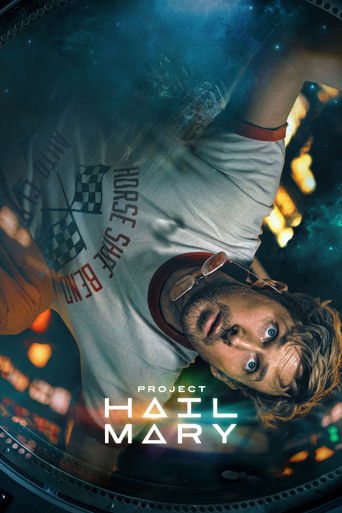
The hardest pivot in modern screen acting is the European-prestige-to-Hollywood-blockbuster crossover. The graveyard is full of arthouse darlings flattened by VFX schedules and four-quadrant scripts — actors whose specificity simply doesn't survive contact with a $200 million pipeline.
THR's David Rooney called Project Hail Mary a "superlative major studio production debut" for Hüller, anchoring a Ryan Gosling-led science-fiction movies epic adapted from Andy Weir's novel. The reason it works, as Rooney's review implies, is structural: Hüller doesn't import prestige into the studio system, she imports realism. She gives Gosling — a generous scene partner already — something concrete to bounce off, and the film becomes more emotionally legible because of it.
And it doesn't stop there. Iñárritu's Digger, with Tom Cruise, is on the way, completing a calendar year that would be enviable across an entire career: a Berlin win, a Cannes Competition title, a wide-release studio sci-fi epic, and an Iñárritu-Cruise collaboration. Most actors spend decades hoping for one of those.
Why This Run Is Historically Unusual
The great actor-runs of recent memory all had a center of gravity. Isabelle Huppert's late-2010s was dominated by European auteurs (Elle, Hong Sang-soo collaborations). Cate Blanchett post-Tár pivoted toward festival prestige with selective Hollywood detours. Toni Collette's mid-2010s indie streak (Hereditary, others) was anchored in genre and American independents.
Hüller's spread is structurally rarer. Two top-three festivals, a major studio tentpole, and an auteur prestige slate (Triet, Glazer, Pawlikowski, Iñárritu) inside a single twelve-month window. She's doing it without a major publicity machine, in two languages, alternating between auteurs the way other actors alternate between agents.
Deadline has labeled her the European actress-of-the-hour and previewed her packed 2026 slate including Rose, Fatherland and Digger, and critic Cláudio Alves at The Film Experience has directly argued 2026 is shaping up to be Hüller's defining year. When Deadline, THR, Letterboxd, and the festival juries themselves are converging on the same reading, "defining actor of the decade" stops being hyperbole. It's just an accurate description of who is showing up where, at what level, this often.
Where to Start If You're Late
If you're catching up, the path is straightforward. Begin with Toni Erdmann for the breakthrough — the role that taught the wider world her register. Move to Anatomy of a Fall for the technique, the way she turns ambiguity into architecture. Then The Zone of Interest for the audacity, and the demonstration that her range isn't a parlor trick but a moral instrument. Catch Rose when MUBI rolls it out later this year.
For completists, the deeper cut is Requiem (2006), the Hans-Christian Schmid film that won her her first Silver Bear and established the spiritual-physical intensity she's been refining ever since. Watch it and you'll see, twenty years early, the actor who would eventually be playing Hedwig Höss and Erika Mann in the same calendar year.
If you'd rather stumble into her catalog the way most great viewing happens — sideways, by accident, between adjacent European auteurs and the films they've shaped — RandomFlix's randomizer pointed at drama movies is a low-friction way to fall down that rabbit hole. Hüller's filmography sits next to Triet's, Glazer's, Pawlikowski's, and a generation of European filmmakers whose work rewards exactly this kind of wandering.
The thesis isn't that Hüller is having a good year. The thesis is that she's quietly assembled, in a single twelve-month window, the kind of run that careers are summarized by. Watch the films. The argument makes itself.