Why Fjord Demands Homework (And Why That's a Compliment)
When Cristian Mungiu walked off the Croisette in May with his second Palme d'Or, the Romanian director quietly joined one of cinema's most exclusive fraternities. Fjord — his English-language debut starring Sebastian Stan and Renate Reinsve — earned him the top prize at the 79th Cannes Film Festival, nearly two decades after 4 Months, 3 Weeks and 2 Days did the same in 2007. Neon, riding a recent streak of Palme-distribution hot hands, snapped up North American rights and is rolling the film out theatrically in the months ahead.
The premise is the kind of moral landmine Mungiu has spent his career defusing in long, agonizing takes: a Romanian Evangelical family living in Norway is accused of child abuse by local authorities, and the cultural, religious, and bureaucratic fault lines crack open from there. The story draws on the real 2015 Bodnariu case, in which Norwegian child welfare services removed five children from a Pentecostal Romanian-Norwegian family — a case that became an international flashpoint for debates about state authority, religious freedom, and immigrant assimilation.
What IndieWire called Mungiu's "signature entropy" is the through-line here: his films don't shout their thesis, they accumulate it, frame by frame, until the weight is unbearable. This is drama movies as moral arithmetic. No jump scares. No tidy catharsis. Just the slow, almost geological pressure of ordinary people being ground against systems too rigid to bend.
While we wait for Fjord's stateside arrival, here are eight films that constitute its cinematic bloodline — three from Mungiu's own escalating filmography, two from his Romanian New Wave peers, and three adjacent works that share its spiritual and tonal DNA. Think of them less as warm-up acts and more as the conversation Fjord is stepping into.
The Mungiu Core: Three Films That Built Toward Fjord
4 Months, 3 Weeks and 2 Days
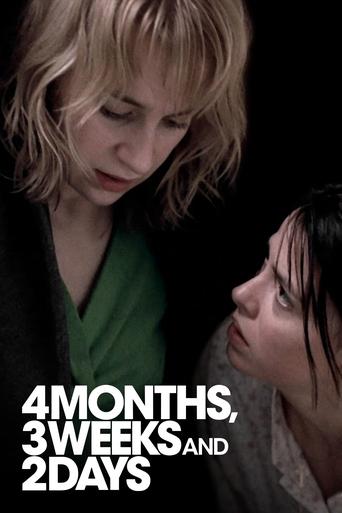
The 2007 Palme winner. The film that put both Mungiu and the Romanian New Wave on the international map. An illegal abortion in the final years of Ceaușescu's regime, rendered in long takes so patient they feel like an act of physical endurance. Two students, a hotel room, a transactional negotiation with a man whose price keeps rising — and a dinner scene shot in a single static take that has become one of the most studied sequences of 21st-century cinema.
This is the blueprint for Fjord's ethics of duration. Mungiu doesn't cut away from discomfort; he asks you to sit inside it until your sense of who is right and who is wrong has been thoroughly scrambled. If you've never seen it, start here. Everything Mungiu has done since is in conversation with this film.
Beyond the Hills
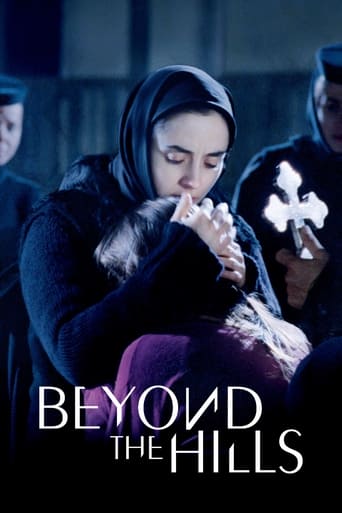
Five years later, Mungiu returned to Cannes with a convent drama based on real events — a young woman's death during an attempted exorcism at a Romanian Orthodox monastery. The film won Best Screenplay and shared Best Actress for its two leads, Cosmina Stratan and Cristina Flutur.
This is where Mungiu first fused religious conviction and institutional failure into a single unbearable knot. The priest isn't a villain. The doctors aren't villains. The friend pleading for the dying woman isn't a villain. And yet something monstrous happens because each party is acting within a system that cannot accommodate the others. Swap the Orthodox convent for a Norwegian welfare office and the Romanian countryside for a fjord-lined village, and you can already see Fjord's architecture taking shape.
Graduation

His 2016 Best Director winner is, on paper, the smallest premise: a provincial Romanian doctor wants to get his daughter a scholarship abroad, and after she's assaulted the day before her final exams, he begins compromising every principle he has ever held. It's a film about how corruption is rarely a single dramatic choice — it's a thousand small accommodations made by good people in a system that punishes integrity.
Of all Mungiu's work, this is the closest tonal sibling to Fjord. The protective parent. The escalating moral panic. The slow recognition that protecting your child may require becoming a person you don't recognize. If Fjord has been described as a culture-war drama, Graduation is its domestic-scale rehearsal.
The Romanian New Wave Context
Mungiu didn't emerge from a vacuum. The Romanian New Wave — that astonishing run of films starting around 2005 — gave him a shared formal vocabulary: long takes, ambient sound, refusal of non-diegetic score, a quasi-documentary insistence on duration. Two films are essential context.
The Death of Mr. Lazarescu
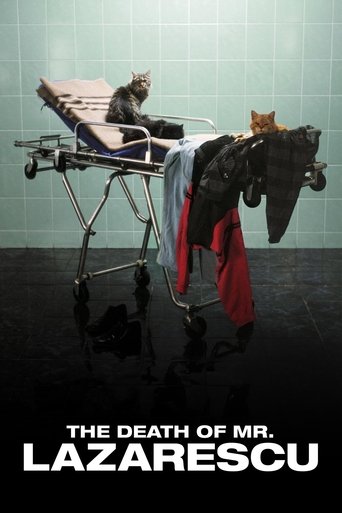
Cristi Puiu's 2005 hospital odyssey is the film that effectively launched the 2000s movies Romanian New Wave. An elderly Bucharest man, drunk and ailing, is shunted from one hospital to another over the course of a single night as doctors, nurses, and paramedics dismiss, mishandle, or simply outlast him. The runtime is punishing. The point is the point.
Puiu taught a generation — Mungiu included — that bureaucratic indifference is its own kind of horror, and that a camera that refuses to look away can become an ethical instrument. When you watch Fjord's social workers and police officers move through their procedures, you're watching Puiu's lineage at work.
Police, Adjective
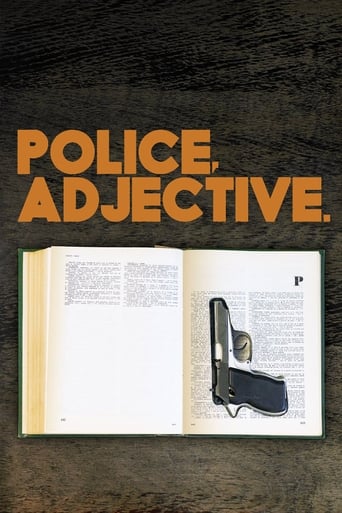
Corneliu Porumboiu's 2009 film is, on its surface, a procedural about a young cop tailing a teenager suspected of sharing hashish with classmates. What it actually becomes — in a now-legendary final scene — is two men in an office arguing the dictionary definitions of conscience, law, and morality, sentence by sentence, for what feels like a small eternity.
It is the most rigorous slow-burn movies morality play the Romanian New Wave produced, and it shares with Mungiu a refusal to editorialize. Porumboiu and Mungiu are peers, not predecessors — but watching them in proximity reveals just how much intellectual ambition this small movement compressed into a handful of years.
Can't Decide What to Watch?
Let RandomFlix pick a movie for you. One click, one great movie.
Roll the DiceThe Adjacent Nordic and Faith Dramas
The Worst Person in the World

Joachim Trier's 2021 film is the work that made Renate Reinsve a star, winning her Best Actress at Cannes. It's essential viewing not just because Reinsve carries Fjord opposite Sebastian Stan, but because Trier and Mungiu — despite very different sensibilities — share an interest in irresolution.
Trier's protagonist drifts through her late twenties making and unmaking choices about love, career, and motherhood, and the film refuses to tell us whether she got it right. It's a character-study movies in the truest sense: a portrait without a verdict. Mungiu works the same muscle, just colder. Reinsve's gift for letting contradictory emotions live on her face simultaneously is exactly the instrument Fjord needs.
Winter Light
Mungiu has long cited Carl Theodor Dreyer and Ingmar Bergman as touchstones, and Bergman's 1963 chamber drama about a Swedish pastor losing his faith is the most direct spiritual ancestor of Fjord's religious doubt. A small congregation. A pastor who can no longer feel God. A parishioner whose despair he cannot reach. Snow, silence, and the terrible weight of being unable to comfort anyone, least of all yourself.
The Nordic landscape is not incidental to either film. Bergman and Mungiu both understand that a certain quality of northern light — cold, clarifying, indifferent — does ethical work that dialogue cannot. When you watch Fjord, watch how Mungiu uses Norwegian winter the way Bergman uses Swedish gray.
R.M.N.
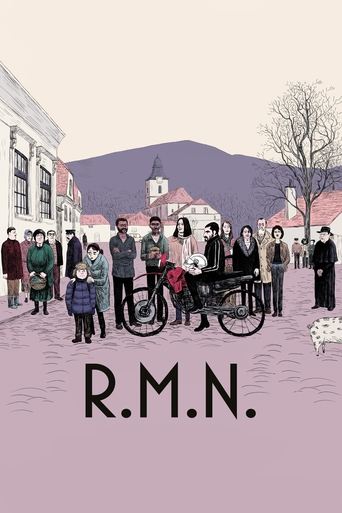
Mungiu's 2022 film about a Transylvanian village erupting in xenophobic panic when a local bakery hires Sri Lankan workers is the immediate precursor to Fjord. The film's centerpiece — a 17-minute town-hall sequence shot in a single take, with dozens of speakers cycling through grievance, prejudice, reason, and rage — is one of the most formally audacious set pieces of the decade.
R.M.N. is where Mungiu's interest in moral chamber drama opened out into culture-war drama: communities, not just individuals, being asked to live with people they don't understand. Fjord inverts the geography — Romanians as the outsiders rather than the gatekeepers — but the thematic engine is the same.
How These Films Talk to Each Other
The Mungiu motif, traceable across every film above, is this: an ordinary person facing an impossible ethical choice inside a system designed to flatten nuance. The girl in 4 Months. The friend in Beyond the Hills. The father in Graduation. The villagers in R.M.N. The parents in Fjord. The system changes — communism, the Church, education, capitalism, child welfare — but the trap is the same shape.
Formally, the continuities are just as consistent. Long takes that refuse the reassurance of editing. Ambient sound where another director would deploy a string section. Wide shots that let secondary characters carry as much weight as the leads. A general distrust of close-ups. These choices aren't aesthetic affectations; they're ethical positions. Mungiu and his peers are arguing, frame by frame, that moral judgment requires duration — that you cannot understand a choice until you have sat inside the time it took to make it.
Watched in sequence, the Mungiu films build toward Fjord with almost embarrassing clarity. Puiu and Porumboiu give you the soil he grew in. Trier gives you the texture of Reinsve's instrument. Bergman gives you the spiritual register Mungiu has been working in all along, even when he's never named it. RandomFlix's foreign-language movies hub is a useful place to keep this lineage handy once Neon's release date firms up.
What to Watch For When Fjord Arrives
Sebastian Stan is in the middle of one of the more interesting mid-career reinventions in American film, and his pairing with Reinsve — their second after A Different Man — is the kind of casting that suggests both actors are chasing something other than franchise paychecks. Listen, too, for what English-language Mungiu actually sounds like. His Romanian-language films have a specific rhythm — clipped, bureaucratic, often funnier than people remember. The translation of that sensibility into English (and Norwegian) dialogue is one of Fjord's quiet experiments.
Watch the snowball structure. Mungiu's films typically withhold their thesis until the final twenty minutes, when what felt like a slow accumulation suddenly reveals itself as an avalanche. Don't check your phone in the third act.
And consider the business story underneath the artistic one. Neon, fresh off distributing recent Palme winners including Anora, is betting on a Romanian auteur's first English-language feature for awards traction. That's a meaningful vote of confidence in a film market that increasingly treats subtitled, slow, morally serious cinema as a hard sell.
These eight films aren't prerequisites. Fjord will work on a cold viewer. But the lineage above is the conversation it's joining, and walking in with that conversation already in your ear turns a strong film into a great one.
Keep the Lineage Going
Save the eight films above and let Fjord land into a prepared mind rather than a cold one. Mungiu has spent twenty years teaching audiences how to watch him. The homework, as it turns out, is the pleasure.