What Actually Happens in the Final 20 Minutes
The last act of Disclosure Day moves with the deliberate calm of a sermon. Margaret Vance, locked out of every official channel and watched by men in unmarked sedans, drives through a thunderstorm to the KCXE affiliate in Albuquerque, walks past a stunned overnight producer, and goes live on the emergency feed with four decades of suppressed records under her arm. Daniel, holed up at the observatory three states away, finally cracks the In Vivo 17 signal in the same minute she starts broadcasting — the harmonic pattern resolves into a single English word. Margaret reads it aloud on air. The screen cuts to black on "Listen."
That's the climax. But the reveal everyone is still arguing about happens fifteen minutes earlier, in the quiet sequence at her sister's cabin. The deer that stood in Margaret's driveway in the prologue, the cardinal that kept tapping the kitchen window, the fox that crossed Daniel's path on the trail to the observatory — they aren't omens, hallucinations, or symbolic flourishes. They're the visitors. As NME laid out in their breakdown, the animals are essentially biological surveillance vessels, the visitors' chosen method of moving through a landscape full of suspicious humans without being shot down or studied to death.
Screenwriter David Koepp has been refreshingly direct about how the film was built. In his Den of Geek interview, he confirmed that the broadcast scene — Margaret at the anchor desk, the word "Listen" hanging in the air — was the first thing Spielberg wrote when he started conceiving the project. Everything else in the screenplay was engineered backward from that image. Which means the film isn't a mystery with a reveal at the end; it's a parable structured around its final beat.
That distinction is the key to the divisiveness. If you walked in expecting a puzzle box, the ending feels withholding. If you walked in expecting a parable, it lands like a hammer.
The Messenger Animals, Decoded
Spielberg shoots each of the three creatures with a different visual grammar, and the pattern is too consistent to be accidental.
The deer always appear in wide, locked-off frames — observers, never moving toward the camera, always at the edge of human space. Cardinals get shallow-focus close-ups, often at windows or against glass, framed like couriers waiting for someone to open the door. Foxes get tracking shots through underbrush, low to the ground, scouting. As the MoviePaws analysis notes, the cardinal motif culminates in Margaret's wardrobe choice for the broadcast: a deep red dress that visually rhymes with every cardinal we've seen for two hours. She has become the messenger she spent the film chasing.
The middle act of the film leans hard into fairy-tale framing. Daniel and Margaret hole up at a remote cottage in the woods that the production design treats like Hansel and Gretel's gingerbread house, complete with warm window light against deep blue night. But Spielberg flips the fable: in this version, the woodland animals are leading the lost children home, not luring them to be eaten. It's the gentlest possible inversion of a very dark story, and it tells you exactly how the director wants you to read his bestiary.
That gentleness reads as radical when you compare it to how the same iconography functions in horror movies cinema. A cardinal at the window in a horror film is a death omen. A fox crossing your path is a witch. A deer staring at you from the tree line is the moment before something terrible happens. Spielberg knows all of this — he's the guy who taught Hollywood how to shoot a shark fin — and he is consciously refusing the menace. The animals aren't watching you because they want to hurt you. They're watching you because they're trying to figure out how to say hello.
'Listen' as Plea, Not Cliffhanger
The most useful reading of the final word comes from Brian Tallerico's RogerEbert.com review, which treats "Listen" not as a sequel hook but as an instruction aimed straight at the audience. The whole film has been about humans who couldn't or wouldn't hear what was being said to them — the government burying the signal, the cable news cycle drowning out Margaret's earlier interviews, Daniel's colleagues laughing him out of the faculty lounge. The final cut to black isn't a tease. It's the movie demanding you sit with the word for a beat before the lights come up.
This is where Daniel's role inverts the Arrival model in a really interesting way. Louise Banks had to learn an alien language that was genuinely alien — heptapod logograms, nonlinear time, a whole new cognitive architecture. Daniel's breakthrough is the opposite. The signal was always in a language humans already speak; he just had to stop filtering it through the assumption that it would be complicated. The visitors weren't hiding. We were the ones refusing to hear.
Koepp's screenplay also drops a quietly devastating piece of worldbuilding in the designation "In Vivo 17." The implication, never spelled out in dialogue, is that there were sixteen prior attempts. Sixteen previous signals, sixteen previous chances, sixteen previous failures of human attention. Disclosure Day is the seventeenth time the visitors have tried, and the first time anyone bothered to translate before classifying.
And then the cut to black. Spielberg denies us the alien face on purpose, and he's been practicing this exact restraint for nearly fifty years. Close Encounters of the Third Kind ends with the Mothership doors opening and a glimpse of the visitors, but the emotional climax happens earlier, in the five-tone musical conversation. Disclosure Day takes that lesson further: no ship, no face, just the word. The point of contact was never the spectacle. The point was always the listening.
Why Critics Are Split
The pro case is best articulated in David Rooney's Hollywood Reporter review, which positions Disclosure Day as the closing panel of a humanist triptych running through E.T. the Extra-Terrestrial and Minority Report — three films separated by decades but united by Spielberg's insistence that empathy is a form of perception, not just a feeling. Read that way, Disclosure Day is the late-career statement of a filmmaker who has finally trusted his audience enough to skip the spaceship.
The skeptical case shows up most clearly in the CBC's review, which argues that the film's structural ambition curdles into something "unsatisfyingly inaccessible," particularly across the third-act time jumps that compress Margaret's decade of research into elliptical montage. The critique is fair on its own terms: if you don't already buy the parable, the elisions feel like the movie ducking the work.
The Rotten Tomatoes consensus splits the difference, framing Disclosure Day as a "humanistic variation" on Spielberg's recurring obsessions and giving most of the credit to Emily Blunt, whose Margaret carries thematic load the screenplay sometimes refuses to spell out. That's a real observation. There are scenes — the cabin reckoning with her sister, the moment she recognizes the cardinal — where Blunt is doing the work of three pages of dialogue with her face. The film leans on her precisely because Spielberg trusts gesture over exposition.
Zoom out and Disclosure Day fits cleanly into the broader 2020s movies wave of contact narratives that have prioritized listening over spectacle — films more interested in the ethics of perception than in the engineering of the ship. The divisiveness isn't really about Disclosure Day. It's about whether you think that whole wave is profound or precious.
Can't Decide What to Watch?
Let RandomFlix pick a movie for you. One click, one great movie.
Roll the DiceSpielberg's Forty-Year Argument, Finished
Every Spielberg contact movie ends with a transmission. The mashed-potato mountain in Close Encounters is Roy Neary receiving a signal he can't yet decode. The bicycle silhouette against the moon in E.T. is the image of a friendship transmitted across an impossible distance. Margaret's broadcast in Disclosure Day is the same gesture in late-career form — older, more institutional, more aware of how easily signals get jammed.
What Disclosure Day rewrites is the optimism of Close Encounters. In 1977, Spielberg could believe that the government scientists at Devils Tower would relay the message in good faith. In 2026, he can't. Margaret has to hijack a local news affiliate because every official channel has spent forty years pretending the signal wasn't there. The visitors haven't changed. The institutions have.
Daniel's arc completes the inversion. Roy Neary climbed onto the ship at the end of Close Encounters; he left with the visitors because the only people who understood him were leaving Earth. Daniel does the opposite. He stays. He stays because translation is now a job that has to be done from inside the conversation, not above it. If the seventeenth attempt is going to land, somebody has to remain on this side of the broadcast to keep interpreting after the credits roll.
If the film has sent you down the rabbit hole on Spielberg's longer conversation with the genre, RandomFlix's science-fiction movies hub is a good place to wander the rest of the lineage.
Three Companion Films That Sharpen the Ending
Close Encounters of the Third Kind
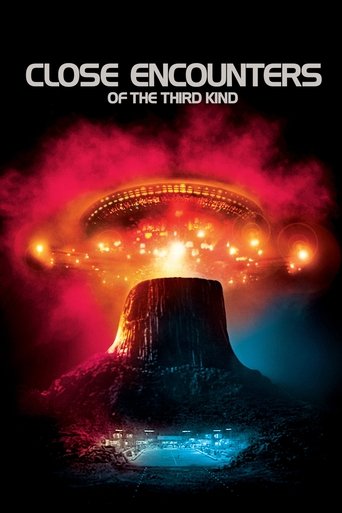
The optimistic ancestor whose final handshake Disclosure Day quietly refuses. Spielberg in 1977 still believed in the possibility of an institutional welcome — Lacombe at Devils Tower, the scientists with their light boards, the whole bureaucratic apparatus working in good faith. Disclosure Day keeps the musical-conversation idea but strips out the trust, which is why Margaret has to broadcast from a commandeered studio instead of a government installation.
Arrival
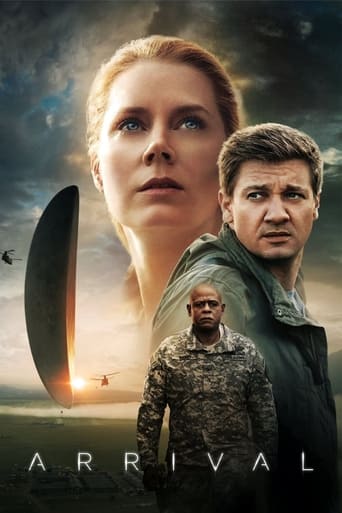
The linguistic-contact cousin, and the cleanest point of comparison for what Daniel is doing. Villeneuve's film treats translation as an act of cognitive transformation — Louise becomes a different kind of thinker by learning heptapod. Daniel's translation work plays differently because he's doing it in a broadcast-news context, against a deadline, with a country half-watching. The intimacy of Arrival becomes the public address of Disclosure Day, and something gets lost and gained in the move.
Nope
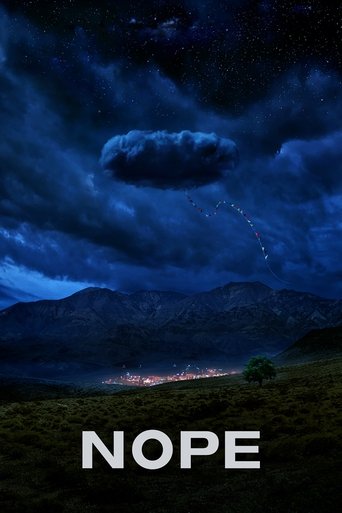
Jordan Peele's animal-as-surveillance read is the most productive counterweight to Spielberg's gentler menagerie. Both films treat the watchful animal as a key to first contact, but Peele's chimps and horses are warnings about the violence of being looked at, while Spielberg's deer and cardinals are invitations to look back. Putting them side by side clarifies how unfashionable Disclosure Day's tenderness really is.
So What Does It All Mean?
The three threads braid into a single argument. The animals are the message — first contact has been happening in your peripheral vision for decades. Margaret is the medium — empathetic communication requires someone willing to be the messenger out loud, on the record, in a red dress under studio lights. "Listen" is the instruction — not to the characters, who already heard, but to us, who almost didn't.
The most common viewer complaint about Disclosure Day is that it never shows the aliens. That's not a bug. That's the entire point of the movie. Spielberg has spent fifty years quietly arguing that the spectacle of contact is the least interesting thing about contact, and Disclosure Day is him finally trusting an audience to sit with the implication. The face you don't see is the face you have to imagine, which is the same cognitive work the visitors have been asking us to do all along.
Remember Koepp's note: Spielberg wrote the ending first. This was never a mystery movie. It was a parable structured backwards from its moral, and the moral is a single word delivered straight into the camera.
If that word stuck with you, the rest of the science-fiction movies canon — and the broader 2020s movies wave of contact stories — is waiting for whatever you bring to it next.