Why Football Cinema Finally Deserves a Serious Ranking
On June 11, 2026, the World Cup kicks off across the United States, Canada, and Mexico — the first 48-team tournament, the largest single sporting event ever staged, and the return of the men's game to North America after thirty-two years. It is also, statistically speaking, the moment the world's most popular sport will once again be embarrassed by its own filmography. Soccer has produced more inert biopics, more limp underdog stories, and more sponsor-friendly hagiographies than any other major sport. The great football films, almost without exception, are about something going badly wrong.
That is the through-line that makes this subgenre worth taking seriously. The best soccer cinema isn't about lifted trophies; it's about Brian Clough's 44 days at Leeds, the French squad refusing to train at Knysna in 2010, Graham Taylor's England disintegrating on a touchline in Rotterdam, an Iranian teenager hiding in a Tehran stadium, a Colombian defender shot dead in a parking lot ten days after an own goal. The genre's masterpieces are studies of rot, politics, and impossible jobs. They understand that football, more than any other sport, is downstream of money, nationalism, and the people who can't quite hold all of it together.
A ranking, then, has to weigh three things: dramatic stakes that survive outside the stadium; what the film actually understands about the sport on a granular level; and rewatchability across a month of group-stage chaos. The recent wave of documentary movies projects tied to the 2026 cycle — France 2010, the 1999 USWNT, a glut of Netflix originals — has only sharpened the criteria. Streamers have figured out that football's interior lives are prestige material. Below is what a serious viewer should know before kickoff.
The Top of the Table: Five Films That Define the Genre
These are the canonical works — the ones a football-curious cinephile should have seen before the group stage starts narrowing the field.
1. The Damned United

Michael Sheen plays Brian Clough taking over Don Revie's Leeds United for 44 catastrophic days in 1974, and the film treats every minute of it as workplace tragedy. Peter Morgan's script — the same Morgan behind The Queen and Frost/Nixon — is more interested in jealousy, class, and a manager's pathological need to be loved than in any match footage. 'The Damned United' depicts Brian Clough's 44-day tenure at Leeds.
What makes it ascend above sports-movie convention is that the football is almost incidental. The film is about a brilliant man who cannot stop antagonizing the people he most needs to impress, and the Revie rivalry it dramatizes is the kind of personal-professional fusion that TIME singled out when it placed the film on its all-time best sports movies list. You don't have to know who Leeds were in 1974 to be wrecked by the final act. Pair it with the broader tradition of based-on-true-story movies dramas — it's that good as straight drama.
2. Zidane: A 21st Century Portrait
Douglas Gordon and Philippe Parreno trained seventeen cameras on Zinédine Zidane for the entire ninety minutes of a single 2005 La Liga match between Real Madrid and Villarreal. There is no commentary, almost no other players in frame, and a Mogwai score that turns each scuff of the turf into something liturgical.
It is the closest cinema has come to capturing what the inside of a footballer's working day actually feels like — the boredom, the muttering, the sudden lurches of geometry, the red card that ends Zidane's afternoon and prefigures, eerily, the headbutt that would end his career a year later. If you watch the 2026 tournament differently after seeing it — slower, more attentive to the off-ball movement television cuts away from — the film has done its job.
3. The Two Escobars
ESPN's 30 for 30 series has produced a lot of fine documentary work, but Jeff and Michael Zimbalist's 2010 film remains the high-water mark of the form. It braids two stories: the rise of Pablo Escobar, whose cartel money funded Colombian football's golden generation, and the murder of national-team defender Andrés Escobar ten days after his own goal eliminated Colombia at USA '94.
The film is the definitive argument that football documentaries can stand alongside any prestige true-crime series. It also supplies essential historical freight for 2026: a tournament returning to North America thirty-two years after the one that ended in a Medellín parking lot. No Film School's ranking of essential soccer films tied to the 2026 World Cup countdown includes 'The Two Escobars.'
4. Offside
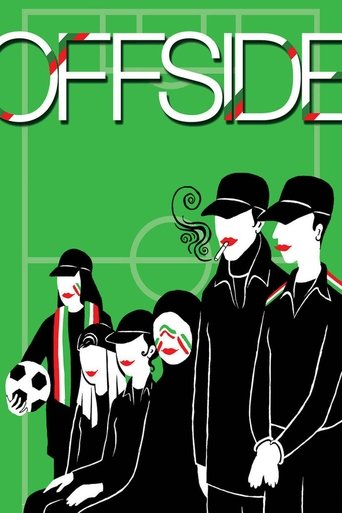
Jafar Panahi's 2006 film follows a group of Iranian girls who disguise themselves as boys to try to enter Azadi Stadium for a 2005 World Cup qualifier against Bahrain — a match women were banned from attending. No Film School identifies 'Offside' as a Silver Bear winner at Berlin.
Panahi shot the film during the actual qualifier, with non-professional actors and a documentary's nerve. The realism is unmatched in the genre because the stakes were literal: a real tournament, a real stadium, a real ban. It belongs in any serious foreign movies cinema conversation, not just the football one, and remains the most morally serious film ever made about the sport.
5. Bend It Like Beckham

Gurinder Chadha's 2002 crossover hit holds up better than almost any of its imitators because its cultural specificity is the whole point. The Sikh family in Hounslow, the wedding subplot, the lectures about chapatis — Chadha understood that a sports movie's universality depends on how unembarrassed it is about its particulars.
It is also the rare populist football film that actually understands amateur play: the bumpy pitches, the coach who doesn't quite know what he's doing, the way teenage ambition collides with parental expectation. Joy is a legitimate criterion for ranking, and Bend It Like Beckham earns its top-five spot against heavier company.
The Documentary Tier: Tournament Prep You Can Stream Tonight
If the canonical five are the prestige reading, the documentary tier is the briefing material — the films that explain why the 2026 tournament will feel the way it does.
Graham Taylor: An Impossible Job
The 1994 Channel 4 documentary that essentially invented modern football access. 'Graham Taylor: An Impossible Job' from 1994 is regarded as the gold-standard fly-on-the-wall World Cup qualifying documentary. A camera crew followed the England manager through the qualifying campaign for USA '94, capturing his unraveling in real time — the touchline pleading, the linesman jokes that became national punchlines, the moment a man realizes his career is ending on television. Every Amazon and Netflix all-access football series since owes it royalties.
Next Goal Wins
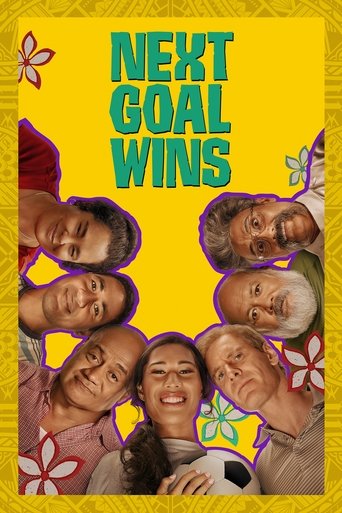
Not Taika Waititi's 2023 dramatization — the original 2014 documentary about American Samoa, the team that lost 31-0 to Australia in 2001 and spent the next decade trying to score a single competitive goal. It is set in exactly the U.S. football periphery the 2026 tournament is about to activate, and it understands that the sport's emotional range is wider than victory and defeat. There is a third register, the one most people actually live in, which is just trying.
The Netflix slate and the FIFA films
Netflix is launching a slate of football documentaries, original films, and unscripted projects ahead of the June 11, 2026 World Cup kickoff, including a documentary on France's 2010 strike and a Mia Hamm/1999 USWNT biopic. The France 2010 project — the Knysna mutiny, Raymond Domenech reading the players' strike letter at a press conference — is the federation tragedy of the modern era, and the obvious next entry in the dressing-room-collapse canon.
Worth digging up too: FIFA's official tournament films. Michael Caine narrating Mexico '86 is its own peculiar pleasure, a relic of an era when the governing body still believed in mythologizing rather than merely monetizing.
Can't Decide What to Watch?
Let RandomFlix pick a movie for you. One click, one great movie.
Roll the DiceThe Fun Tier: When the Group Stage Drags
By the end of week two of a World Cup, you have watched a lot of football. The third match of a triple-header day, on a Tuesday afternoon, between two teams already eliminated, is exactly when the prestige tier stops being viable. These are the films for then.
Shaolin Soccer
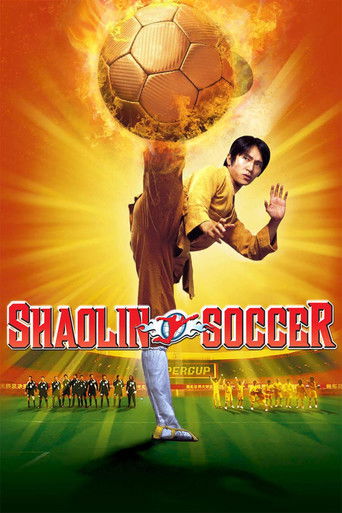
Stephen Chow's 2001 wuxia-football hybrid is the most rewatchable thing on any list of this kind — a film in which a former Shaolin monk recruits his estranged brothers for a football tournament and they discover their kung fu translates, somehow, into bicycle kicks that set the ball on fire. It treats football the way kung fu films treat martial arts: as a vehicle for spectacle, brotherhood, and bone-deep silliness. No Film School's countdown of essential soccer films includes 'Shaolin Soccer.'
Escape to Victory

John Huston directing Sylvester Stallone, Michael Caine, Pelé, and Bobby Moore in a 1981 film about Allied POWs playing a propaganda match against a German team in occupied Paris. It is ridiculous on every available axis and completely essential viewing — partly because Pelé's bicycle kick is real, partly because Stallone playing goalkeeper is one of cinema's stranger casting decisions, and partly because Caine, at this point in his career, would commit to anything. No Film School also includes 'Escape to Victory' in its essential soccer films list.
Mean Machine

Vinnie Jones in the British prison-football remake of The Longest Yard — a film that is deeply silly and deeply committed to its silliness, which is the only honorable approach. It belongs on any sports movies shortlist alongside the heavier dramas, because a tournament that lasts a month needs both registers.
Watching With the Tournament
The smart move is to front-load the heavy dramas — The Damned United, The Two Escobars — before June 11, so the group stage doesn't dilute their weight. Zidane and Offside reward the patience of a rest day between rounds, when the noise quiets and the next knockout hasn't started building yet. The fun tier handles itself; that's the point of it.
The genre's central insight, the one that links every film above, is that football is never really about football. It is about the people who try to manage it, the federations that try to monetize it, the families that try to survive it, and the players who, for ninety minutes at a time, have to pretend any of that can be controlled. The 2026 tournament will produce its own version of every story on this list — a sacked manager, a federation scandal, a goalkeeper who becomes briefly famous, a 1990s movies-style underdog run that no algorithm saw coming. Watching the films first means you'll recognize the shapes when they arrive.
When the Round of 16 schedule leaves a gap and nothing on the bracket is calling you, RandomFlix's dice roll is a fine way to surface a forgotten football oddity you'd never have thought to search for. The rest of the time, the list above is the one to work through.
Kickoff is June 11. Start with Clough.