Why Toy Story 5 Forces a Re-Rank
On June 19, 2026, Pixar reopens a story most of us assumed was sealed shut sixteen years ago. The premise is unusually pointed: Greta Lee voices Lilypad, a tablet that infiltrates Bonnie's room and threatens to do to Woody and the gang what no claw machine, daycare, or antique store ever managed — make them irrelevant. Andrew Stanton, returning to direction after Finding Dory, has framed the project as a mirror held up to swipe culture, a generation of kids whose attention now belongs to glass rectangles instead of plastic figures.
That framing changes how the prior four films should be judged. Nostalgia rankings have done their rounds; box-office rankings are settled. What hasn't been done is a re-rank keyed specifically to the question Stanton is now asking out loud: which Toy Story film best understood that obsolescence — not separation, not loss, not even growing up — was always the franchise's real subject?
Because it was. From Buzz's identity crisis to Jessie's owner, Pixar's secret Toy Story project has been a forty-year meditation on becoming obsolete. The tablet villain just makes the metaphor literal.
So the criteria here are three: how well each film dramatizes obsolescence, how well it earns its emotional climax, and how it plays in 2026 with a tablet-shaped reckoning around the corner. For broader context on where these films sit in the larger animation movies canon — or just the wider family movies conversation — the rest is a re-rank built for the moment, not the memory.
4.
Toy Story 4 — The Sequel That Picked the Wrong Fight
The fourth film is technically immaculate and thematically misdirected, and the Lilypad lens makes that misdirection harder to forgive. The critical consensus has been circling this for years — Collider and Inside the Magic have both argued the film struggled to justify its existence after the third installment delivered what felt like a definitive farewell.
The craft is undeniable. Gabby Gabby is a genuinely tragic antagonist — a defective pull-string doll whose villainy is really just grief in a Victorian collar. The antique-store sequences are some of the most beautifully lit images Pixar has ever rendered. Bo Peep's reinvention as a leather-wrapped survivor is earned, sharp, and overdue.
But the existential question the film picks — does a toy need a kid? — is the wrong one for this franchise's through-line. The Toy Story spine has always been about what happens when the world stops needing you, not about whether you need the world. Stanton's pitch for Toy Story 5 — do toys matter when kids have screens? — is the question Toy Story 4 should have been asking. Instead, it built a road movie around Woody's vocational crisis and called it a thesis.
Forky compounds the problem. He's a brilliant five-minute gag stretched into a worldview the character can't carry. A spork doesn't have anything to say about obsolescence; he's a creature whose entire existence is the opposite of being thrown away. The film mistakes novelty for relevance, which, with Lilypad on the horizon, reads as the exact mistake the franchise can't afford to repeat.
This is the Toy Story sequel that ages worst the closer we get to a tablet villain.
3. Toy Story — The Original, Reconsidered
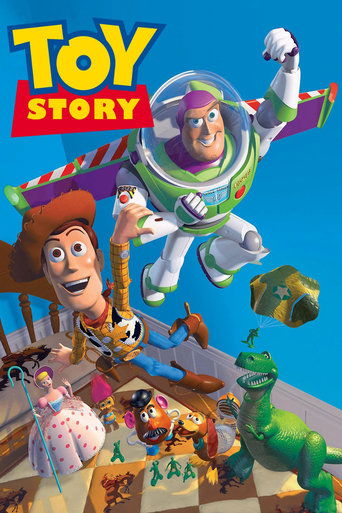
The 1995 original lands third here not because it's a lesser film — it's the most rewatchable and leanest of the four — but because in a re-rank keyed to thematic depth, the 1990s movies debut is more setup than payoff.
Credit what it invented. The first feature-length CG film. The Woody-and-Buzz template that every animated buddy pairing since has been borrowing from. The toy's-eye-view of human domestic life, which is the lens the entire franchise still runs on. Without these load-bearing innovations, none of what follows exists.
And the obsolescence anxiety is there — in embryo. Woody's jealousy of Buzz is, very literally, a fear of being replaced by newer, flashier technology. Buzz is a battery-powered, light-up, voice-chip-equipped piece of next-gen plastic muscling into a hand-me-down cowboy's place at the top of the bed. That conflict is the franchise's whole future in miniature.
But the original resolves it as friendship rather than reckoning. Woody and Buzz become partners; the threat dissolves into the warmth of a shared owner. It's the right answer for the movie it's in — a Christmas-shaped resolution to a Christmas-shaped film — but it points at the larger question rather than answering it.
For readers chasing that pure buddy-comedy movies energy, the first film remains the platonic ideal. On the toys-vs-tech axis, it's prologue.
2.
Toy Story 3 — The Ending That Almost Closed the Book
The third film ranks second, and the case has to be made honestly because the case is almost a case for first. The incinerator scene and the hand-off to Bonnie remain Pixar's most devastating one-two punch — one minute the toys are clasping hands in the face of literal annihilation, the next Andy is kneeling in the grass introducing his childhood to a stranger. Nothing in this franchise has matched that gear-shift.
ScreenRant has noted, fairly, that the third film treads thematic ground the second film already plowed — Lotso is, in his strawberry-scented way, a Stinky Pete with a Southern accent and a grudge. The point is conceded. But the execution transcends the retread. Lotso's villainy is angrier, more political; the daycare is a prison-movie set piece; the climax is operatic in a way the second film, for all its emotional precision, never reached for.
What pushes Toy Story 3 this high in a Lilypad-focused re-rank is that it's the film that made obsolescence feel like grief rather than plot. Andy growing up is the slow-motion version of what Lilypad threatens to do overnight. The toys aren't broken, aren't lost, aren't replaced — they're simply not needed anymore, and the film treats that absence as the deepest wound it can imagine.
Why not first, then? Because it solves the franchise's central problem so completely that everything after it — including, potentially, Toy Story 5 — has to justify reopening the wound. A film that perfect at closure is, paradoxically, a difficult foundation for a franchise asking new questions. It earns its tears; it doesn't quite earn the sequels it makes inevitable.
Its kinship with other animation movies tearjerkers — Up, Coco, The Wild Robot — is real and worth honoring.
Can't Decide What to Watch?
Let RandomFlix pick a movie for you. One click, one great movie.
Roll the Dice1.
Toy Story 2 — The One That Saw Lilypad Coming
The second film tops this list, aligning with Movieguide's ranking but for a sharper reason than craft or nostalgia: it's the only Toy Story film that treats obsolescence as a systemic threat rather than a personal one. Every other entry is about a specific toy fearing a specific replacement. Toy Story 2 is about an entire economy of forgetting.
Jessie's "When She Loved Me" sequence is the franchise's emotional Rosetta Stone. A child outgrows a toy not because the toy fails, not because something better arrives, not because anyone is cruel — but because the world simply moves on. Emily doesn't reject Jessie; she ages out of her. That mechanism — the quiet, structural march of attention away from objects — is exactly the mechanism Lilypad represents in scaled-up, screen-shaped form. The fifth film's premise is the second film's montage with a Wi-Fi signal.
The Al's Toy Barn plot, meanwhile, has only sharpened. In 1999 it was a satire of collector culture; in 2026, in the age of resale apps, limited-drop Funkos, and grown adults bidding three figures on sealed action figures, it reads as something close to prophecy. Toy Story 2 understood that toys exist inside markets, and markets eat childhoods. That insight is what the franchise's tech-era reckoning has to inherit.
And Stinky Pete remains the franchise's best villain because he's right about something. Toys do get abandoned. Children do grow up. His pitch to Woody — preservation behind glass instead of the slow heartbreak of a fading bedroom — is monstrous, but it's not stupid. He articulates an uncomfortable truth the heroes have to argue against, not merely defeat. Every Pixar villain who lands lands for the same reason: they're saying something the film can't easily dismiss.
Lilypad, if Stanton is doing his job, will be the tech-era answer to Stinky Pete. Not a tablet that's evil for the sake of menace, but a tablet that makes a point about where attention goes and why. If Toy Story 5 is going to land, it has to learn from Toy Story 2, not Toy Story 4. That's the argument of this whole piece.
What This Re-Rank Predicts About Toy Story 5
The ranking doubles as a forecast. The Toy Story films that took obsolescence seriously as a structural force aged better than the ones that staged great rescues, and Stanton has been talking about Lilypad as a structural force — a mirror to swipe culture, a sinister AI rather than a gimmick antagonist. That language is closer to Stinky Pete than to Forky, and closer to systemic dread than to road-trip noodling.
If the fifth film leans on the second film's playbook — systemic obsolescence, a villain who articulates an uncomfortable truth, a montage that locates grief in the simple passage of attention — it has a real shot at the top half of this list. If it leans on the fourth film's playbook — existential noodling, a new toy with a gimmick, a hero figuring out what he personally wants — it ends up at the bottom.
Lilypad as sinister AI could be the Stinky Pete of the 2020s. Or she could be a louder Forky. The framing of swipe culture suggests Stanton knows the difference; the June 19 release will tell us whether the script does.
In the meantime, the back catalog still hits. The first film is the leanest comfort watch; the second is the one to revisit with adult eyes; the third remains the goodbye that won't stop working; the fourth is worth re-engaging if only to test this re-rank against your own. For broader pre-screening, the wider animation movies shelf and the coming-of-age movies adjacencies — Pixar's quieter, sadder, smarter cousins — are where the franchise's themes echo loudest.
Skip the marathon if you want. Watch the Jessie sequence. That's the trailer for Toy Story 5 nobody cut.