The Movie Star Nashville Almost Kept From Us
The news came in late August, and the tributes followed the shape you'd expect: the songs, the theme park, the philanthropy, the wigs. What kept getting shorter shrift, buried three paragraphs down in most obituaries, was the strange parallel career Dolly Parton kept building on movie screens. Roughly a dozen feature credits, a scattering of TV movies, decades of variety specials — a filmography small enough to hold in one hand and yet stubbornly, repeatedly rewatchable.
Part of the reason critics keep circling back is that Parton's screen debut was engineered by people who understood exactly what they had. According to press materials preserved in the Herbert G. Luft Papers, when 9 to 5 was being sold to the industry in 1980, Jane Fonda predicted Parton "could be a great movie star" — and the casting itself was a deliberate calculation to broaden the picture's Southern and mainstream reach. That gamble paid off so completely that it's easy to forget how weird it was: a first-time actress, no drama-school pedigree, holding her own opposite two of the most decorated women in American film.
The through-line across everything that followed is that Parton almost never played anyone but "Dolly." That was the point. Like Cary Grant playing Cary Grant, or her comedy movies contemporary Bette Midler leaning into Bette, Parton's persona was the instrument — Southern, self-deprecating, sexually confident without ever being smutty, and blessed with comic timing you cannot teach. What follows is a ranking weighted toward performance and staying power, not opening weekend: two masterpieces, a beloved disaster, a pair of underseen TV movies, and one genuinely strange rhinestone western.
The Ranking: 9 Dolly Parton Performances Worth Revisiting
1. 9 to 5 (1980)
Her debut, and still the film that defines her screen presence. As Doralee Rhodes, the misunderstood secretary who fantasizes about roping her sexist boss like a calf, Parton did what most first-time actors can't manage in ten pictures — she made an entire cultural archetype feel freshly minted. Rotten Tomatoes notes that Fonda cast Parton and Tomlin knowing all three could take on stereotypes about working women, and the ensemble gave Parton exactly the cover she needed to essentially play herself.
The title song, Oscar-nominated for Best Original Song, became a labor anthem that outlived the picture that spawned it. Slot it next to the other feminist workplace comedies of the 1980s movies and you can see how far ahead of the curve it was — and how much of that lift Parton personally provided. Rotten Tomatoes' critical consensus calls it a bright and enjoyable comedy anchored by three lead performances. Few debuts have ever done more work.
2. Steel Magnolias (1989)
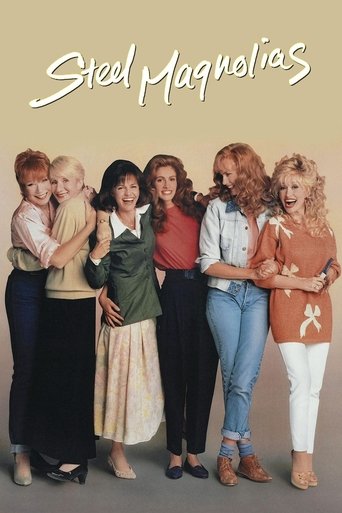
As Truvy Jones, the beauty-shop owner holding a Louisiana town's gossip together, Parton anchored a cast of Oscar winners — MacLaine, Field, Hannah — without ever pushing to the front of a frame. The trick of the performance is generosity: Truvy is written as the one who keeps everyone else talking, and Parton plays her almost entirely in reaction shots, feeding lines with the timing of someone who has spent a lifetime hosting a variety show.
The Boston Globe framed the picture as her return to good movie territory after a rough mid-decade stretch, and Rotten Tomatoes' consensus still notes that it has jokes and characters to spare. Sally Field, in her tribute after Parton's death, singled out exactly that generosity as a scene partner. It remains one of the essential drama movies ensembles of its era, and Parton is the reason its comedy still lands as hard as its tragedy.
3. The Best Little Whorehouse in Texas (1982)
Opposite Burt Reynolds as Miss Mona, the madam of the Chicken Ranch, Parton got a role written for her voice and warmth — a musical she could theoretically wear like a favorite jacket. The problem, as she'd say later, was the production. Parton herself called the shoot a miserable, spirit-numbing ordeal, and you can see the compromise on screen: the stage musical's edge sanded down to accommodate two mega-wattage stars.
And yet — this is where "I Will Always Love You" entered the film canon, six years before Whitney Houston made it a global phenomenon. It's a fascinating case study in what happens when a persona is bigger than the material around it. Miss Mona survives the movie almost in spite of the movie.
4. Straight Talk (1992)

Parton as Shirlee Kenyon, a Southern dance instructor who accidentally becomes Chicago's most beloved radio therapist, opposite a surprisingly game James Woods. Yahoo Entertainment's retrospective flagged the film as one of five Parton titles worth revisiting, and it deserves the second look. This is the romantic comedy Hollywood built specifically around her — one of the last of its kind before the genre pivoted to Julia Roberts and Meg Ryan vehicles — and it's underrated for how completely Parton carries a movie without an ensemble to bounce off.
5. A Smoky Mountain Christmas (1986)
The made-for-TV movie directed, improbably, by Henry Winkler, in which Parton plays a country star who flees to her Tennessee cabin and stumbles into a Snow White riff involving seven orphans and a mountain witch. It sounds absurd because it is absurd. It plays like Appalachian fairy tale, and it's the purest expression of the Dolly-as-folk-heroine persona ever committed to film. A holiday perennial that never quite got the streaming-era rediscovery it deserved.
Start a Watchlist
Keep track of every movie that catches your eye. Your watchlist, your rules.
Start Your Watchlist6. Wild Texas Wind (1991)
An NBC TV movie with Gary Busey as an abusive bandleader Parton's honky-tonk singer must escape. Wide Open Country's ranking of Parton's feature work makes room for underseen titles including Wild Texas Wind and A Smoky Mountain Christmas, and the appreciation is deserved: she wrote the songs, co-produced, and pushed the material somewhere darker than anything else in her filmography. The performance most critics missed because it aired on a Monday night in September and vanished.
7. Rhinestone (1984)

Sylvester Stallone as a New York cabbie Parton bets she can turn into a country singer in two weeks. Yes, really. A legendary bomb — but Parton is inarguably the best thing in it, and the fish-out-of-water movies premise plays better today than it did in 1984, when critics were still reeling from the fact that this was what Stallone chose to do after Rocky III. Camp classic status secured; watch it double-featured with any of her serious work and you'll appreciate the range.
8. Unlikely Angel (1996)
A CBS holiday movie in which Parton, as a deceased country singer, must reunite an estranged family to earn her wings. The rare comic-fantasy premise that leans directly into her gospel roots without turning preachy, and a role that functions as a kind of career summary hiding inside a TV Christmas movie. Parton the songwriter, Parton the folk theologian, Parton the sitcom warmth-generator — all of them are in this one performance.
9. Joyful Noise

Her late-career reunion with big-screen musical comedy, sparring with Queen Latifah as rival choir directors in a small Georgia town. The reviews were mixed, but the two leads generate real heat, and Parton's original songs give the film its spine. A gentle exit from feature filmmaking that suggests what a second act might have looked like if she'd been interested in one.
What the Ranking Reveals
Two things become obvious across these nine titles. First, she rarely worked with great directors — Colin Higgins, Herbert Ross, Bob Clark, Henry Winkler — and it barely mattered, because the camera loved her whether the frame around it was competent or not. Second, she was a much stranger and more interesting screen actor than her mainstream reputation lets on. There's a reason the same handful of performances get re-litigated every time she comes back into the news cycle.
Looper's ranking of her best screen work highlights that Parton received an honorary Jean Hersholt Humanitarian Award in 2025 and was nominated twice for Best Original Song — for 9 to 5 and Transamerica. Those two nominations, three decades apart, are the bookends of a career that always treated songwriting as the primary vocation and acting as a wonderful accident. The Looper piece goes so far as to argue that 9 to 5 turned her into a real movie star, though the fuller catalog argues she was already one by temperament and simply chose music.
Compare her arc to the other music-icon-turned-actor experiments in musical movies history — Prince, Madonna, Whitney, Mariah, Beyoncé, Gaga — and Parton belongs in the small subset who translated completely. She didn't build a shadow filmography of vanity projects. She made a handful of films, chose the ones she believed in, and left.
How to Watch Her Now
The two essentials — 9 to 5 and Steel Magnolias — are widely streaming and effectively never out of rotation on cable. The TV movies require more hunting; some drift through Tubi's free tier, others exist only on physical media traded among Parton completists. RandomFlix's Roll the Dice is a decent way to surface the Southern ensemble comedies and 1990s movies romantic comedies that share her DNA, since her own filmography is too small to sustain a marathon by itself.
The Hollywood Reporter's critical tribute described her body of screen work as small but indelible, and that's finally the right frame. Parton was the rare star whose on-screen self was inseparable from the woman America just lost — which is why her nine movies, unlike most stars' fifty, are worth going back to on purpose. Start with Truvy holding court in the beauty shop. See how much a great actor can do just by listening.