Why La Bola Negra Feels Like the Culmination of Something
There's a particular hush that fell over the Princess of Wales Theatre when the final title card of La Bola Negra dissolved into black. One hundred and sixty minutes had passed, three lives had risen and fallen and risen again across the tectonic shifts of post-Franco Spain, and Los Javis — Javier Ambrossi and Javier Calvo — had done something the international art-house circuit has been waiting years for: they'd made a queer epic that behaves like an epic. Not a coming-of-age miniature. Not a chamber piece. A sprawling, generation-braided melodrama with the confidence to stretch a single sustained ache across four decades.
Then the audience voted. La Bola Negra, a decades-spanning gay romance from Spanish filmmakers Los Javis, was named winner of the Toronto International Film Festival's 2026 People's Choice Award, and in doing so it became a marquee Oscar contender before most of the world had even glimpsed a trailer. The 160-minute film pairs Spanish singer-songwriter Guitarricadelafuente with Penélope Cruz and Glenn Close, and it made history as the first Netflix film to win TIFF's top prize. That People's Choice track record is not a footnote — since 2012, every People's Choice winner has gone on to receive a Best Picture Oscar nomination, which is why the film's trajectory from Cannes buzz to Toronto ovation is being read as the opening move of an awards season.
But awards arithmetic isn't why La Bola Negra lingers. What lingers is its shape. Three gay men — a poet, a bureaucrat, a fisherman-turned-restaurateur — whose lives cross and recross for roughly forty years, from the twilight of dictatorship through the excesses of La Movida and into a present-day Spain still tallying its losses. That braided architecture, the way the film folds birthdays and funerals and reunions into a single continuous present tense, doesn't resemble the intimate queer coming-of-age wave that's dominated the last decade. It resembles something older, weightier, more European: the queer epic as a form of collective memory.
The eight films below share that emotional register — the ache of survived time, the ritual of chosen family, desire remembered as clearly as desire lived. They stretch from the 1980s movies through last year, and together they map the lineage La Bola Negra is quietly, magnificently completing.
The Almodóvar Throughline
You cannot talk about Los Javis without talking about Pedro Almodóvar. The lineage is not a coincidence; it's a foundation. Almodóvar's career has always centered on multi-dimensional queer characters, from his early Movida provocations through his mature masterpieces, and every Spanish filmmaker working in a queer register since the mid-1980s has had to reckon with the vocabulary he invented — the saturated palette, the sacred-profane collision, the mothers and lovers and priests entangled in the same melodramatic knot.
What La Bola Negra inherits most directly is Almodóvar's belief that a gay life is worth the full-orchestra treatment: the swooning score, the operatic timelines, the Douglas Sirk color-blocking. Where earlier generations of queer cinema often whispered, Almodóvar bellowed. Los Javis, raised on that permission, now bellow across four decades. The two Almodóvar films on this list function as bookends of his own autobiography — one from the moment queer Spanish cinema kicked the door in, one from the vantage of a filmmaker looking back down the corridor.
Eight Films That Share La Bola Negra's Emotional Register
These are arranged roughly chronologically within each filmmaker's arc, and weighted toward works that fold decades into a single narrative rather than isolated love stories. Each entry maps a specific rhyme with La Bola Negra — the braided timeline, the generational grief, the art-as-memory device — rather than plot synopsis for its own sake.
Law of Desire
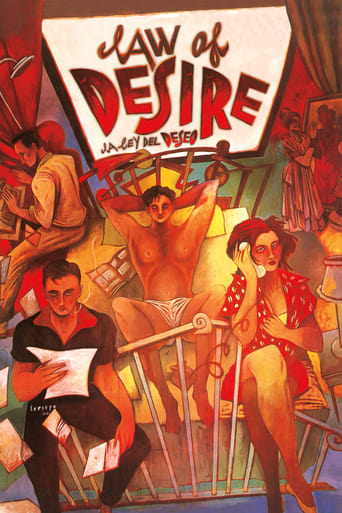
Almodóvar's 1987 breakthrough is the moment gay desire stopped being subplot and became the engine of Spanish auteur cinema. The film's plot — a filmmaker, his transgender sister, an obsessive lover — plays now like a manifesto: this is what we get to make movies about, and this is how big we get to make them. The Madrid nightlife scenes, all sweat and pink neon and pre-AIDS abandon, read as prehistory for the world Los Javis are eventually elegizing. When La Bola Negra's oldest characters recall their first bars, their first apartments, their first funerals, they're remembering a city that Law of Desire filmed while it was still happening.
Pain and Glory

If any single film is the tonal cousin of La Bola Negra, it's this one. Antonio Banderas plays a stand-in for Almodóvar himself — a filmmaker in the winter of his career, sifting through decades of loves, drug use, mothers, and abandoned scripts. Almodóvar's late-career self-portrait extends the pioneering project of putting complex queer lives at the center of his cinema, and its central reunion scene between former lovers — two men in a doorway, decades of unsaid things compressed into ten minutes — is essentially the template Los Javis stretch across two-and-a-half hours. Both films perform the same alchemical trick: they collapse a lifetime into a present-tense reckoning without ever feeling like biography.
Happy Together

Wong Kar-wai's Buenos Aires two-hander is the outlier in geography and the perfect match in mood. Two lovers, one destination, an entire relationship's arc rendered as fragments and repetitions — a slow tango, a fight, a reconciliation that both parties know won't hold. The film's long stretches of loneliness and exile rhyme directly with La Bola Negra's melancholic middle passages, where characters drift for years between the reunions. For anyone who wants queer love filmed with genuine formal ambition, this remains a cornerstone of the romance movies canon — as much a memory piece as a love story.
Brokeback Mountain

Ang Lee's twenty-year chronicle is still the mainstream benchmark for a gay love story told across decades, and it earns the comparison to La Bola Negra in one specific way: the closing act. Both films trust silence and elapsed time to do the work that dialogue can't. Both understand that grief, in a queer life shaped by concealment, is often the grief of everything unsaid. If you're new to the lgbtq movies epic tradition and want the accessible on-ramp, this is where the road begins.
Distant Voices, Still Lives

Terence Davies' 1988 Liverpool memory-piece is the closest formal cousin La Bola Negra has anywhere in world cinema. Davies gained international art-house acclaim with Distant Voices, Still Lives and its 1992 companion The Long Day Closes, working-class family albums where hymns, pub songs, domestic violence, and repressed longing all share the same frame. His non-linear editing — a wedding dissolving into a funeral dissolving into a childhood bath — is the direct ancestor of Los Javis' braided timelines. Davies' autobiographical Liverpool films merge memory, music and his own fraught relationship with his queerness, which gives the ostensibly straight family drama its distinctive undertow: a gay filmmaker rendering his own past through his sisters' lives.
Benediction

Davies' penultimate film finally makes the subject text. Benediction, his biopic of the WWI poet Siegfried Sassoon, features an openly gay romance that culminates the queer subtext running through his earlier work. The Jack Lowden / Peter Capaldi split-timeline device — the same soul embodied by two actors, young and old, cutting across each other in the same scenes — is another key to the structural playbook La Bola Negra draws from. If the older-years passages of Los Javis' film were what devastated you, this is the essential Davies entry: a gay man aging through a century that couldn't hold him.
Can't Decide What to Watch?
Let RandomFlix pick a movie for you. One click, one great movie.
Roll the DiceBPM (Beats per Minute)

Robin Campillo's ACT UP Paris drama supplies the collective, activist counterweight to La Bola Negra's more intimate braid. Where Los Javis follow three individual lives, Campillo films a whole movement — the meetings, the die-ins, the arguments about tactics — and then narrows to a single sickbed with unbearable precision. The final act, in which illness, chosen family and a lover's body converge, is the single most direct emotional analogue on this list. Any conversation about the generational grief humming beneath La Bola Negra's later chapters has to pass through this film.
Carol

Todd Haynes' 1952-set romance is here as the lesbian counterpart to the tradition, and because Haynes' entire filmography is a study in period longing. The line runs cleanly from Douglas Sirk through Almodóvar to Los Javis: melodrama as queer historical form, the woman's picture and the gay picture converging on the same emotional grammar. Two people carrying an entire era in a glance across a department store. Pair it with Happy Together for a double bill on how two lovers can hold a whole decade between them.
Where to Go From Here
The thread doesn't end at eight. Pull it further and you land in the broader drama movies shelf, in the 1990s movies New Queer Cinema wave — Haynes' own Poison, the early films of Gus Van Sant, the ferocious Gregg Araki trilogy — and in a dozen international pockets that keep reissuing the queer epic in new dialects. Many of these older titles are the exact ones that streaming algorithms tend to bury under whatever's new this week, which is where a service like RandomFlix's shuffle can occasionally do you a favor by surfacing a Davies or a Campillo you'd otherwise scroll past.
What La Bola Negra's TIFF win most clearly signals isn't a breakthrough. It's a homecoming. The epic queer film — sweeping, unashamed, willing to hold decades of desire and mourning in a single frame — has been here the whole time, from Law of Desire through Distant Voices through BPM. Los Javis simply built a big enough house to invite all of it in at once. Watch the eight above and you'll see the blueprints they were working from, and you'll understand why the theatre in Toronto went so quiet before it started clapping.