The Week Jaws Goes Back to Peacock and Shark Week Returns to Max
Every summer, the shark movie reasserts itself as one of the most stubbornly alive corners of horror movies. This July, the timing is unusually good. Discovery's annual ocean extravaganza kicks off on cable and streaming with a full week of new specials, and the film that started the whole fin-shaped panic has quietly resurfaced on a rival service — meaning the completists have Jaws covered, and the rest of us can spend the seven nights afterward digging into the strange, spiky, wildly uneven films that swam in its wake.
Shark Week 2026 runs July 26 through August 1, with a lineup that leans into premieres like Air Jaws: Red, White & Breach and the frankly irresistible Jaws vs. Orca. It's a natural pretext to take the also-rans seriously. Jaws turned 50 in 2025, and half a century is more than enough time to stop measuring every other shark picture against Amity Island and start asking a better question: which of these movies actually did something new?
Why the Best Shark Movies Refuse to Be Jaws
Here's the counterintuitive thing critics tend to circle around: the shark films that hold up worst are the ones that most obviously want to be Jaws. Slavish imitation — the sleepy beach town, the reluctant sheriff, the third-act boat hunt — has produced dozens of forgettable knockoffs and exactly zero classics. The films worth watching are the ones that took Spielberg's mechanical shark as permission rather than template.
Jaws' DNA is honestly more visible outside the water than in it. You can trace its methodical-suspense engine into Alien, its small-town creature panic into Tremors, its "nature strikes back" grief-horror into Godzilla Minus One. When the subgenre stayed literal — man vs. fin — it either had to reinvent the frame or drown. The two dominant modes that emerged both refuse the Amity template. One is minimalist survival: open water, one location, a horizon that keeps not offering rescue. The other is maximalist spectacle: labs, tornadoes, sunken cities, prehistoric monsters the size of buses. The films below span roughly three decades and belong to one camp or the other — or, in the best cases, invent a third.
The Minimalist Survival Wave
Open Water

The film that reset what a shark movie could be for less money than most productions spend on catering. Chris Kentis's 2003 experiment was shot for $500K and grossed $55M, and it did that by removing almost everything audiences expected from the subgenre. No boat siege. No mayor. No John Williams. Just two divers accidentally left behind by a charter, and the slow, awful arithmetic of realizing help isn't coming. The sharks are barely characters; the ocean itself is the monster. It's shot on video, deliberately ugly, and unbearable in the best way — the argument for survival-horror movies as the natural home for shark cinema after Jaws.
The Reef
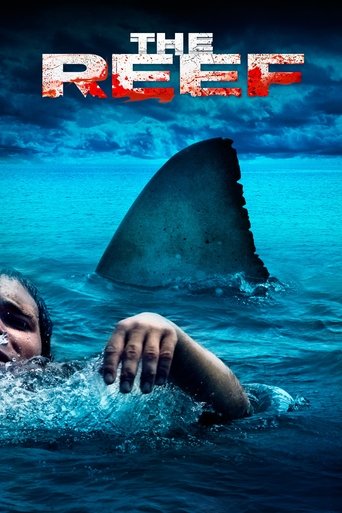
Andrew Traucki's 2010 Australian nightmare took Open Water's premise and added a crucial constraint: real great whites, no CGI, no cage rigs. The result is a film whose scares carry documentary weight. When a fin cuts the surface between the swimmers, you're watching an actual shark, and the movie's argument becomes uncomfortably clear — the scariest predator is the one that already exists, unedited, in the world outside the frame.
47 Meters Down
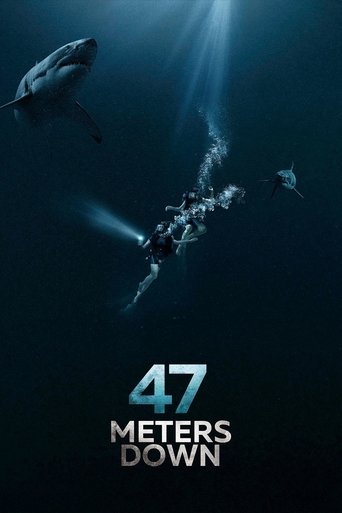
Johannes Roberts's 2017 cage-dive picture flips the survival formula in a smart way: the sharks are the environment, not the antagonist. Two sisters trapped on the ocean floor in a broken cage aren't being hunted so much as slowly ground down by depth, dwindling air, and the mathematics of nitrogen narcosis. The great whites circle almost incidentally. It's a claustrophobia film that happens to have teeth, and its final act pulls one of the meaner tricks the thriller movies space has managed this century.
The Shallows
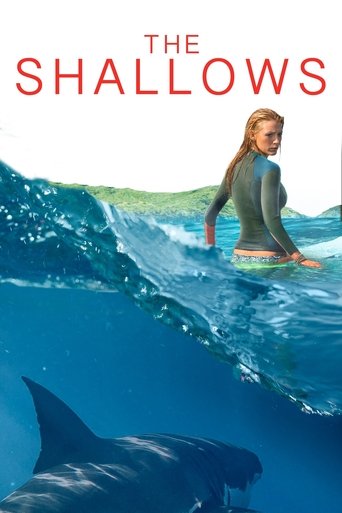
Jaume Collet-Serra's 2016 surf-cinema entry is the closest anyone has come to making a shark movie Jaws didn't want to be. Blake Lively vs. a rock, a buoy, a wounded seagull, and 200 yards of blood-warm water — the film is essentially a survival-thriller chamber piece staged against some of the prettiest cinematography the subgenre has ever produced. It's also the rare post-Jaws shark movie whose protagonist gets to be genuinely resourceful rather than just terrified.
The Big-Swing Spectacles
Deep Blue Sea
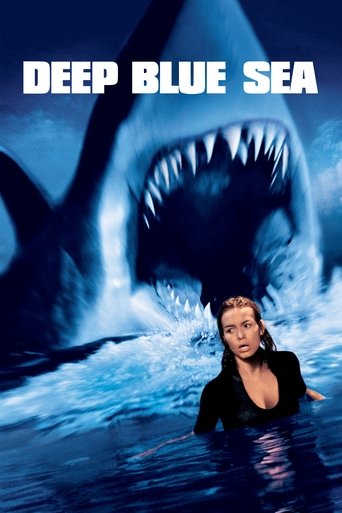
Renny Harlin's 1999 lab-shark opus is a legitimate touchstone. The premise — genetically enhanced makos in a submerged research facility — sounds absurd on paper and plays like a house on fire on screen. It contains the greatest monologue interruption in 1990s movies cinema, a genuinely sincere case for LL Cool J as final girl, and a willingness to kill off cast members in the wrong order that still catches first-time viewers off guard. Critics who write about non-Jaws shark films almost universally circle back to it as the movie that proved spectacle didn't have to mean stupidity.
The Meg
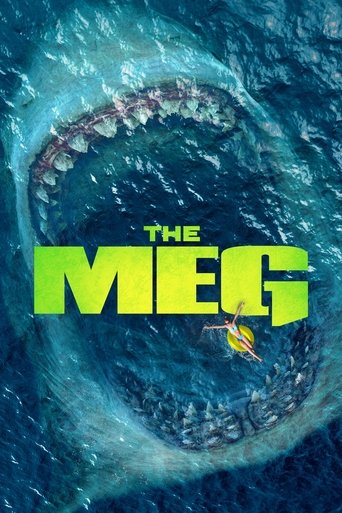
Jason Statham vs. a prehistoric megalodon, filmed on a Chinese-American co-production budget that could have funded a small country's navy. The genius of The Meg is that everyone involved understood the assignment: dumb on purpose, expensive on purpose, aware that the audience is there to watch Statham glower at a fish the size of a nuclear sub. It's one of the very few post-Jaws blockbusters to justify its scale, and it did well enough to earn a sequel — evidence, if any were needed, that the appetite for maximalist shark cinema hasn't decreased since 1975.
Can't Decide What to Watch?
Let RandomFlix pick a movie for you. One click, one great movie.
Roll the DiceBait
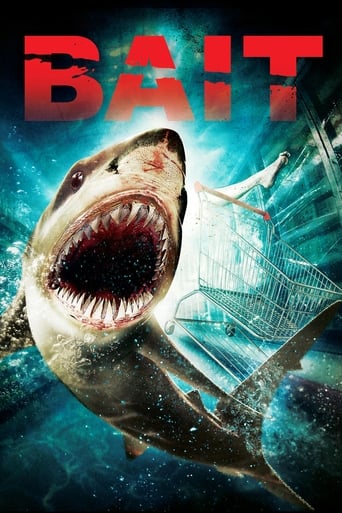
Kimble Rendall's 2012 Australian oddity may be the purest expression of the "commit fully to the premise" school of shark filmmaking. A tsunami traps shoppers inside a coastal supermarket. The floodwaters bring great whites. That's the movie. The remarkable thing is how earnestly it plays — no smirking, no winks — until the sheer conviction of the concept tips it into something accidentally sublime. It's the kind of film that shouldn't work and absolutely does.
Sharknado
Included here not as a recommendation but as a genuine turning point in the subgenre. The Syfy phenomenon split shark cinema into two lanes — self-aware camp and everything else — and the ripples are still visible. Understanding it briefly is useful; watching all six is a lifestyle choice this article won't endorse.
The True-Story and New-Wave Entries
12 Days of Terror
The 2004 dramatization of the 1916 New Jersey shore attacks is the ur-text hiding in plain sight. Those attacks — a series of maulings along the Jersey coast and, bizarrely, up a tidal creek in Matawan — were the real events that inspired Peter Benchley to write Jaws. Watching the dramatization now is a strange, doubled experience: you can see every beat that Spielberg would eventually formalize, but stripped of the myth-making. The mayor character is a real mayor. The panic is documented. It's the shark movie as historical reconstruction, and it makes Jaws feel, briefly, like a cover version.
Under Paris
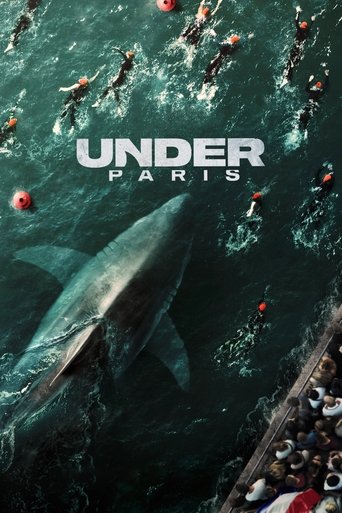
Xavier Gens's 2024 Netflix hit is the most politically pointed shark movie ever made, which is a sentence I did not expect to type. The premise — a mako has adapted to the freshwater Seine ahead of a triathlon staged for city PR — is played straight, and the film uses it to skewer municipal corruption, climate denial, and the specific French genius for prioritizing image over safety. Its final ten minutes are among the most demented in recent horror movies, and they land because the movie earned them.
Dangerous Animals
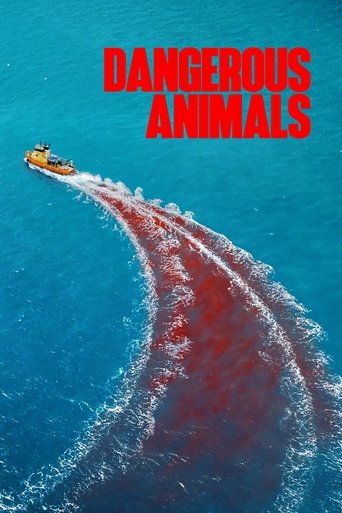
The 2025 Cannes premiere fuses serial-killer thriller and shark movie into something that shouldn't work on paper: a surfer abducted by a shark-obsessed captain who feeds his victims to the water. It's the year's strongest argument that the subgenre still has ideas — that after fifty years of fins, someone can still find a new angle. This is not a Jaws knockoff. It's barely a shark movie in the conventional sense. It's the shape of what comes next.
An honorable mention belongs to The Black Demon, a 2023 entry that leans hard into Mesoamerican mythology to give its shark a mystical dimension. It's flawed, but its willingness to be about something — pollution, corporate guilt, folkloric memory — puts it in the right conversation.
Programming the Week
The trick, if you're taking Shark Week as an excuse to actually watch films rather than just Discovery specials, isn't chronological order or ranking. It's contrast. One minimalist survival picture — Open Water or The Reef — will scour your nervous system clean. One big-swing spectacle — Deep Blue Sea, The Meg, or Bait — will remind you why the subgenre keeps drawing budgets in the first place. One true-story or new-wave entry — Under Paris, Dangerous Animals — will suggest where it's going.
The deeper you dig into adjacent shelves — the 2010s movies in particular produced an unusually rich bench of open-water dread — the clearer the pattern becomes. Jaws is untouchable. It should be untouchable. It's also the wrong film to imitate. The shark movies worth catching up on this July are the ones that stopped trying, found their own tonal identity, and made the water strange again.
Skip the imitators. Watch the rebels.